-
Artificial Intelligence (AI) – What You Need to Know Factsheets
Artificial Intelligence (AI) is technology that enables computers to analyze information, identify patterns, and provide useful responses or recommendations. As AI tools become more common, youth and families may have questions about their use. When used responsibly, AI can be a valuable tool in special education. The following resource sheets provide information and guidance to help answer common questions about AI and its role in supporting students and families.
- Artificial Intelligence (AI) in Special Education: What Families Need to Know Parent Factsheet (April 2026)
- Artificial Intelligence (AI) in Special Education: What Families Need to Know Parent Factsheet (Spanish) (April 2026)
- Artificial Intelligence (AI) in Vocational Rehabilitation and Independent Living Parent Factsheet (April 2026)
- Artificial Intelligence (AI) in Vocational Rehabilitation and Independent Living Parent Factsheet (Spanish) (April 2026)
- Artificial Intelligence (AI) in Vocational Rehabilitation and Independent Living Youth Factsheet (April 2026)
- Artificial Intelligence (AI) in Vocational Rehabilitation and Independent Living Youth Factsheet (Spanish) (April 2026)
- Artificial Intelligence (AI) in Vocational Rehabilitation and Independent Living Youth Visual Factsheet (April 2026)
- Artificial Intelligence (AI) in Vocational Rehabilitation and Independent Living Youth Visual Factsheet (Spanish) (April 2026)
- Using AI as a Tool – Preparing for Special Education Meetings (April 2026)
- Using AI as a Tool – Preparing for Special Education Meetings (Spanish) (April 2026)
-
Communication: Vocational Rehabilitation (VR) and Independent Living (IL) Factsheets
Good communication helps you get support and reach your goals. When you communicate clearly and listen, people understand you better, and things move forward. It can help you make decisions, avoid confusion, and have good relationships with the people you work with. Some people communicate using words; others use sign language, pictures, or other supports, such as a computer. The following resource sheets provide information and guidance to help with communication skills.
- Effective Communication with Vocational Rehabilitation and Independent Living Services Factsheet for Parents (April 2026)
- Effective Communication with Vocational Rehabilitation and Independent Living Services Factsheet for Parents (Spanish) (April 2026)
- Communication: Vocational Rehabilitation and Independent Living Youth Factsheet (April 2026)
- Communication: Vocational Rehabilitation and Independent Living Youth Factsheet (Spanish) (April 2026)
- Communicating with Vocational Rehabilitation and Independent Living Youth Visual Factsheet (April 2026)
- Communicating with Vocational Rehabilitation and Independent Living Youth Visual Factsheet (Spanish) (April 2026)
-
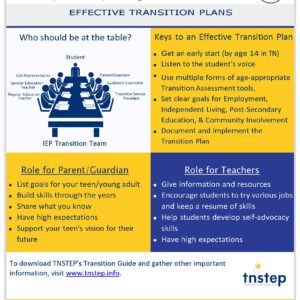
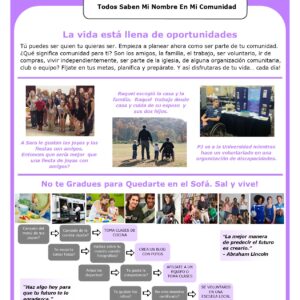
Effective Transition Plans – WAZE Factsheet (Bilingual) Planes de Transición Efectivos
This document was created under the WAZE to Adulthood project in collaboration with TNSTEP and PEATC.
Click here to download the PDF version.
-
TNSTEP Newsletters (Los boletines de TNSTEP)
TNSTEP Newsletter Winter Edition 2026 Español
TNSTEP Newsletter Fall Edition 2025 Español
TNSTEP Newsletter Summer Edition 2025 Español
TNSTEP Newsletter Spring Edition 2025 Español
TNSTEP Newsletter Winter Edition 2025 Español
TNSTEP Ahead Newsletter Winter Edition 2024 Español
TNSTEP Ahead Newsletter Summer Edition 2024 Español
TNSTEP Ahead Newsletter Winter Edition 2023 Español
TNSTEP Ahead Newsletter Spring Edition 2023 Español
TNSTEP Ahead Newsletter Summer Edition 2023 Español
TNSTEP Ahead Newsletter Fall Edition 2023 Español
TNSTEP Ahead Newsletter Winter Edition 2022 Español
TNSTEP Ahead Newsletter Spring Edition 2022 Español
TNSTEP Ahead Newsletter Summer Edition 2022 Español
TNSTEP Ahead Newsletter Fall Edition 2022 Español
STEP Ahead Newsletter Winter Edition 2021 Español
STEP Ahead Newsletter Spring Edition 2021 Español
STEP Ahead Newsletter Summer Edition 2021 Español
STEP Ahead Newsletter Fall Edition 2021 Español
STEP Ahead Newsletter Spring Edition 2020
STEP Ahead Newsletter Summer Edition 2020 Español
STEP Ahead Newsletter Fall Edition 2020 Español
STEP Ahead Newsletter Spring Edition 2018
-
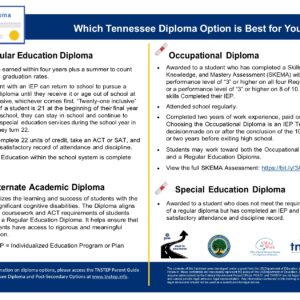
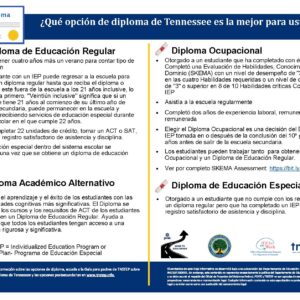
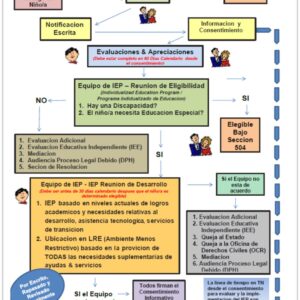
Which Tennessee Diploma Option is Best for You? WAZE Factsheet (Bilingual) ¿Qué opción de diploma de Tennessee es la mejor para usted?
This document was created under the WAZE to Adulthood project in collaboration with TNSTEP and PEATC.
Click here to download the PDF version
-
z ¿Qué opción de diploma de Tennessee es la mejor para usted? (Which TN Diploma Option is Best for You)
Haga clic aquí para continuar leyendo en Español
Este documento fue creado bajo el proyecto WAZE to Adulthood en colaboración con TNSTEP y PEATC.
-
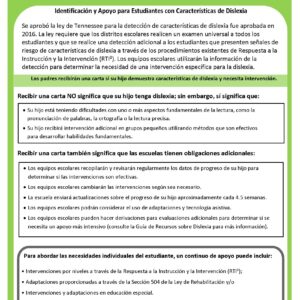
z Descripción general de la dislexia para padres (Dyslexia Overview for Parents Information Sheet)
Haga clic aquí para continuar leyendo en Español
Este documento fue creado en colaboración con TNSTEP y el Departamento de Educación de Tennessee.